

Why Is My Child Blinking So Much?
It can be quite worrying to notice your child suddenly blinking a lot — especially when the blinking looks forceful or repetitive.
Many parents immediately wonder:
- Is this an eyesight problem?
- Could something be wrong with my child’s eyes?
- Is this something neurological?
The reassuring truth is that excessive blinking in children is actually quite common, and in most cases, it is harmless and temporary.
As both a parent and an optometrist, I’ve gone through this myself — and I understand how concerning it can feel when you first notice it.
In this article, I’ll walk you through the most common causes of excessive blinking in children, share my own experience, and explain when it’s worth getting it checked.
A Real Example: My Toddler Blinking a Lot
I first noticed my child blinking quite forcefully when he was around 3+ years old.
It wasn’t just normal blinking — it appeared more exaggerated, repetitive, and sometimes in bursts rather than constantly. Naturally, I started observing more closely.
Here is a real video example of what I saw in my child:
If you watch closely, you’ll notice:
- the blinking is repetitive
- it appears forceful
It was happening a couple of times throughout the day; although he didn’t seem bothered by it at all. He continued with his usual activities, and there were no other obvious symptoms.
As a parent, that can be a very helpful sign — children who are uncomfortable from eye irritation or pain will usually show it through rubbing, tearing, or complaints.
Why Is My Child Blinking So Much?
Excessive blinking in children is most commonly caused by eye irritation, allergies, refractive error (need for glasses), or temporary blinking tics. In many cases, it is benign and easily manageable, and blinking related to habit tics often resolves on its own over time. However, persistent or worsening symptoms should be assessed by an eye care professional.
Common causes:
- eye irritation (allergies, dust, lashes)
- need for glasses (refractive error)
- eye alignment issues
- blinking tics
Let’s go through them in more detail.
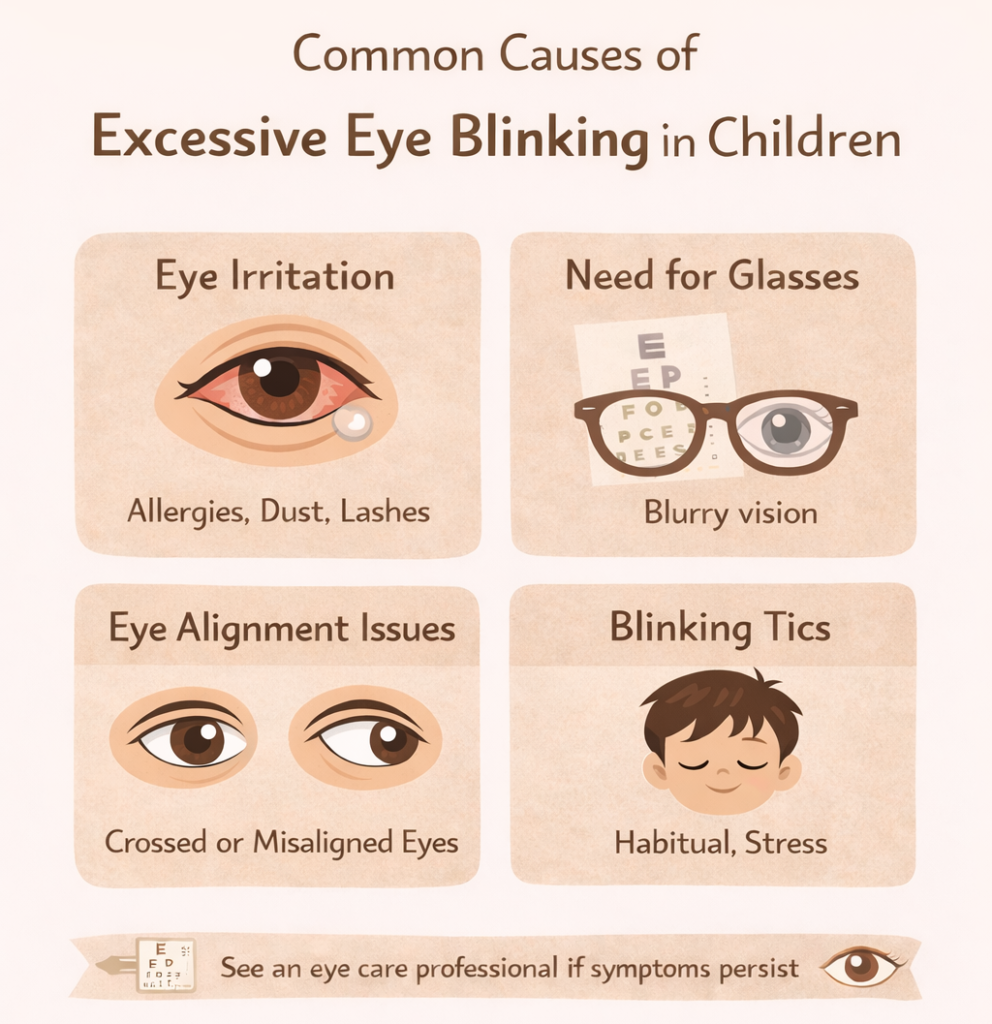
Common Causes of Excessive Blinking in Children
1. Irritation from the Front Surface of the Eye
This is one of the most common causes of frequent blinking in children.
a. Allergies
Children with eye allergies often have itchy eyes, redness, tearing and frequent eye rubbing. This usually affects both eyes, and there is often a history of allergies.
b. Foreign Bodies (e.g. dust, sand, eyelashes)
Sometimes something small gets into the eye. Children may say: “There’s something in my eye”. You may notice more forceful blinking, especially after outdoor play or sand exposure.
c. Inward Growing Lashes (Epiblepharon)
This is common in young Asian children.
A small fold of skin near the eyelid causes the lashes to turn inward, irritating the eye surface and creating a constant foreign body sensation.
d. Corneal Abrasion
Small scratches on the eye surface may occur from:
-
-
- minor trauma (e.g. fingernails, pets)
- aggressive eye rubbing (especially when there is already a trapped foreign body under the eyelid)
- contact lens–related issues like improper insertion/removal (some young children may be using contact lenses for myopia control)
-
This can cause pain, tearing, sensitivity to light and increased blinking.
e. Dry Eyes (especially with screen time)
When children use screens excessively, the blink rate decreases and eyes dry out. This can trigger frequent blinking, as each blink helps to spread a fresh layer of tears across the eye surface.
2. Refractive Error (Need for Glasses)
Conditions like:
- myopia (short-sightedness)
- hyperopia (long-sightedness)
- astigmatism
can cause blurred vision.
Some children blink more in an attempt to “clear” their vision.
3. Eye Turn (Squint / Strabismus)
This refers to misalignment of the eyes:
- inward (esotropia)
- outward (exotropia)
When the eyes are not aligned, the brain receives different images from each eye, which can reduce visual clarity or cause double vision. Some children blink as a way of trying to “reset” or improve their visual alignment, especially when they are tired.
4. Tic Disorders
A tic is a sudden, brief, repetitive movement (motor) or sound (vocal).
Examples include:
- blinking
- facial grimacing
- shoulder shrugging
- throat clearing
Tics are:
- more common in boys
- can be triggered by stress, fatigue, or transitions
- usually temporary
a. Habit Tic (Provisional Tic Disorder)
This is the most common type.
These “habit” tics are typically short-lived and self-resolving.
b. Chronic Tics (Persistent Tic Disorder) and Tourette Syndrome
These two conditions are less common than habit tics.
Chronic tic (Persistent Tic Disorder) involves motor or vocal tics (but not both) lasting for more than 1 year.
Tourette syndrome involves both motor and vocal tics that persist for more than one year.
How Common Are Tics in Children?
Habit tics (Provisional Tic Disorder) are more common than you think.
- An estimated 4–20% of children may experience these temporary habit tics
- Tourette syndrome affects only ~0.3–1% of children
This is very reassuring — most cases are transient.
What I Did as an Optometrist and Mom
While my training guided what I looked out for, these are actually signs that most parents can easily observe at home.
I looked out for:
- eye redness
- tearing
- eye rubbing
- vision difficulties (e.g. walking closer to the TV/whiteboard)
- eye misalignment
I also noticed that:
- he was not bothered by the blinking
- episodes were not linked to specific activities; it happened randomly at home and in school
- he could still see clearly — even spotting a tiny aeroplane far away
(It’s also worth noting that some vision problems can affect just one eye, so this alone doesn’t completely rule things out.)
It may also help to:
- observe patterns (when it happens)
- reduce potential allergens (e.g. dust mites, soft toys)
- check with teachers
In my case, the video was captured by his childcare teacher while he was trying to nap, and they had occasionally noticed it during class as well.
How Long Does It Last?
The duration depends on the cause.
For habitual blinking tics, symptoms often:
- resolve within weeks to a few months
In my child’s case, it turned out to be a habit tic that resolved in less than 2–3 months, even before we became truly concerned.
When Should Parents See a Doctor?
You should consider getting it checked if:
- blinking is persistent or worsening
- your child seems bothered
- it is interfering with school activities or daily life
- there is redness, discharge, light sensitivity or pain
- there are vision concerns
- there are additional motor or vocal tics
- or anytime you are unsure
When in doubt, it is always reasonable to seek a professional evaluation.
What to Expect During an Eye Check
If you visit an optometrist or ophthalmologist, the assessment typically includes:
- visual acuity (clarity of vision) – reading letters, numbers, or pictures on a chart
- refractive assessment – checking vision with different lenses to see if glasses are needed
- eye alignment check – assessing how well both eyes move/work together
- eye health examination – using specialised instruments (such as a slit lamp microscope) to examine the front and back of the eye
Most of these are quick and non-invasive.
The Good News: Most Cases Are Harmless
The good news is that most cases of excessive blinking in children are benign and manageable.
A prospective study of 99 children with excessive blinking found that the most common causes, in descending order, were:
- eyelid or eye surface issues
- habitual tics
- refractive error (need for glasses)
- eye misalignment
This reinforces that most cases:
✔ are not serious; or self-limiting
✔ are easy to diagnose and manage
Common FAQ
When should I worry about blinking?
If the blinking is persistent, worsening, or associated with other symptoms, it’s worth getting it checked.
What are the treatments for excessive blinking?
Treatment depends on the cause, but in general:
- mild irritation or allergies can be managed with lubricating or anti-allergy eye drops
- dry eyes may improve with reduced screen time and artificial tears
- refractive error can be corrected with glasses
- habitual tics often do not require treatment and improve on their own with time and reassurance
Is excessive blinking linked to autism?
Excessive blinking alone is not a definitive sign of autism.
While some children with autism may show repetitive behaviours, autism typically also involves broader developmental differences such as delays in communication, reduced eye contact, or difficulty with social interaction.
In some children with autism, increased blinking may be part of self-regulating behaviours, often related to sensory sensitivity or feeling overwhelmed.
If there are concerns beyond blinking, a professional evaluation is advisable.
Is excessive blinking a sign of ADHD?
Tic disorders can be associated with ADHD and OCD, particularly in more complex cases like Tourette syndrome.
However:
- most children with simple blinking tics do not have ADHD
- children whose tic symptoms persist over time are more likely to have associated behavioural conditions
As explained by resources such as add.org, it is also important to note that ADHD itself does not cause tics, although children with ADHD may be more prone to experiencing them.
Final Thoughts
If your child keeps blinking a lot, it’s completely understandable to feel concerned.
Observe, monitor, and seek help whenever you feel doubtful.
One helpful tip is to take a short video of the blinking episodes. This can be very useful for your doctor, especially if the symptoms are not always present during the consultation.
In many children, this is a phase that improves with time.
References
- Coats DK, Paysse EA, Kim DS. Excessive blinking in childhood: a prospective evaluation of 99 children. Ophthalmology. 2001.
- Tang N, Wang Y, Jiang X, Liu H, Li Y, Qu J, Xiang S. Clinical characteristics of tic disorders in children and adolescents with abnormal blinking. Frontiers in Psychiatry. 2025.
- Greydanus DE, Tullio J. Tourette’s disorder in children and adolescents. Translational Pediatrics. 2020.
- American Academy of Ophthalmology. Excessive blinking in children.
- Cleveland Clinic. Tics and tic disorders.
- Attention Deficit Disorder Association (ADDA). ADHD and Tics.